


When studying infertility cases, the main focus is usually placed on women. However, the male factor plays a fundamental role due to its fertilizing capacity. This can decrease due to circumstances such as alcohol consumption, lifestyle, or a sedentary routine lacking physical activity. All of this leads to a drastic decline in sperm quality, which may result in difficulties conceiving naturally.
If this happens, assisted reproduction becomes the only way to achieve fatherhood. Thanks to various selection techniques or devices, such as the swim-up, density gradients, and the Fertile Chip, specialized professionals can select sperm with better motility and morphology, thereby increasing the success rate of the treatment.
It consists of processing the semen in order to “select” an adequate number of sperm with the potential capacity to fertilize the oocyte, emulating the capacitation and selection that occur during the physiological journey through the female tract.
Below, we will take an in-depth look at the methods used, how they differ from one another, and why this is so important in the laboratory when the male factor is the limiting element.
At Ovoclinic, we routinely perform the semen processing technique using density gradients and the Fertile Chip device to select sperm with lower DNA fragmentation.
What is the density gradient technique?
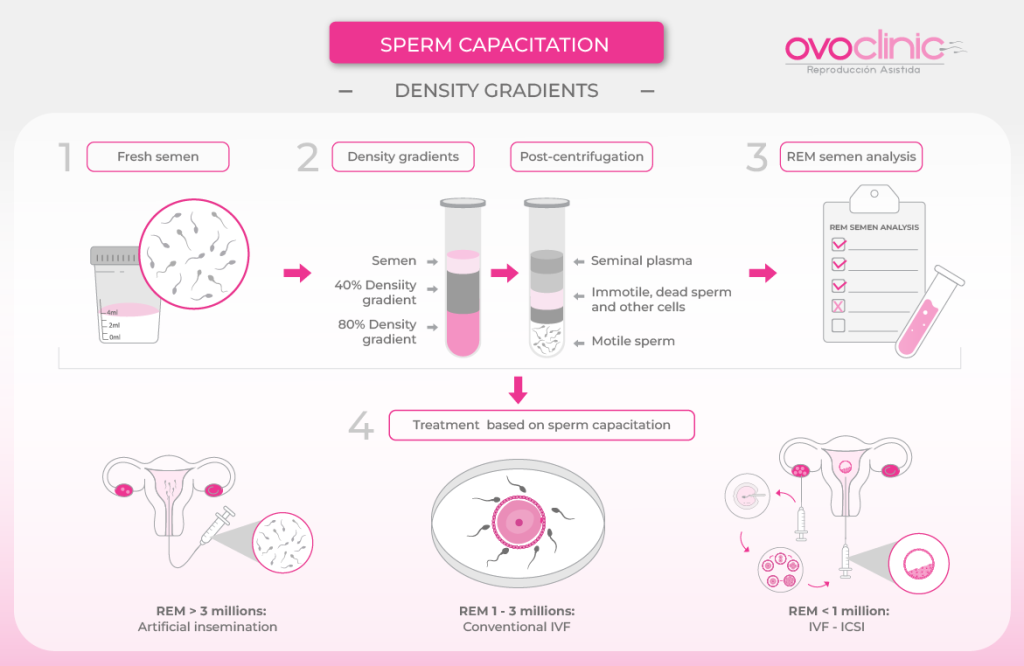
Density gradients is a sperm capacitation method in which two media of different densities are used. This technique mimics the natural process that sperm undergo in the female reproductive tract, allowing the selection of those with higher motility and quality for assisted reproduction treatments.
To perform the procedure, the media are placed in a laboratory tube, followed by the semen sample. After centrifugation, the sperm with the best qualities will be able to pass through the gradients and reach the bottom of the tube—emulating the behavior they would have in the female tract. These sperm will be selected, as they are the ones with the best progressive motility.
What is the swim-up technique?
This technique consists of selecting the best sperm based on their ability to “swim” in a specific culture medium, thereby enhancing their fertilizing capacity.
It is performed using a semen sample, which is first centrifuged to concentrate the sperm at the bottom. Once this initial step is completed, a culture medium is added and the tube is incubated at body temperature (37ºC), in an inclined position, for 30 to 60 minutes.
After this time, the sperm that remain motile and swim upward in the culture medium are considered good, while the immobile ones stay at the bottom and are considered poor-quality.
Once the procedure is complete, it becomes clear which sperm will be selected to attempt to fertilize the woman’s egg. According to various studies, sperm recovered through the swim-up technique and density gradients are comparable to those of the fertile male population. This highlights the high value of both techniques and the strong likelihood of achieving a successful pregnancy.
What is the difference between swim-up and swim-out?
Although the basis and function of the technique are the same, its use and process differ. Less commonly used, swim-out refers to the process of collecting motile sperm by removing the upper culture medium instead of retrieving the upper fraction of the medium.
However, it is less common to find these techniques in assisted reproduction laboratories, as the swim-up technique is preferred due to its excellent results.
Why are swim-up and density gradients important?
These techniques, according to scientific studies, avoid exposing human cells to reagents whose long-term effects are not yet known, thus allowing the recovery of sperm from semen with better translational and structural characteristics. Moreover, they serve as an applicable method in low-complexity assisted reproduction techniques, such as Intrauterine Insemination, where the natural selection of the sperm that will fertilize the oocyte is still viable.
Semen count and evaluation
Once the sperm capacitation process is completed, regardless of the method used, a semen quality assessment and a count of high-quality sperm must be performed.
The result of this analysis is expressed as the number of motile sperm with straight trajectories per milliliter of ejaculated semen. This is known as REM (motile sperm count).
This technique and its result also help determine male infertility. For this reason, tests such as the REM semen analysis or REM sperm capacitation test are performed.
Although indicative, the results of capacitation are generally associated with assisted reproduction techniques as follows:
- REM greater than 3 million motile sperm per ml of semen: artificial insemination is recommended.
- REM between 1 and 3 million motile sperm per ml of semen: conventional in vitro fertilization (IVF) is recommended.
- REM below 1 million motile sperm per ml of semen: intracytoplasmic sperm injection (ICSI) is indicated. When this occurs, Ovoclinic offers triple sperm selection, which includes, among other methods, the previously mentioned density gradients.
The final results of sperm capacitation will determine which treatment is most appropriate and has the highest chance of success. At Ovoclinic, we recommend regular testing such as semen analysis to assess sperm quality and the chances of achieving natural conception.


