

The excellence of Ovoclinic’s professionals is not only in the laboratory, but also in their ability to research and contribute value to the scientific community. The embryologists at our centre have reached a worldwide milestone with the publication of a scientific study on oocyte devitrification in the prestigious Journal of Assisted Reproduction and Genetics, which soon to be indexed in the biomedical repository PubMed.
This recognition shows the commitment, the qualification of the professionals and the teamwork in favour of assisted reproduction and, consequently, of science. In this way, in addition to training embryologists from all over the world, Ovolearning professionals also contribute advances to this particular field where so much research is needed.
This multicentre study has an international impact, as it positively affects all clinics specialised in assisted reproduction. Thanks to this exhaustive study, we now have a more illustrative and real perspective on the Universal Warming Protocol (UWP), achieving greater optimisation and efficiency in the processes of oocyte devitrification. This is essential for all assisted reproduction clinics and their success rates.
The aim of the research was to demonstrate the efficacy of the Universal Warming Protocol (UWP) using different means of devitrification in donor oocytes that were previously vitrified in a single egg bank.
For the methodology of the study, 2172 metaphase II oocytes were used. All of them were vitrified in Ovobank (Spain). These oocytes were devitrified in three different centres: with Kitazato media (Japan), with Irvine media (USA) and with RapidWarm media (Sweden).
The study parameters were survival rate, fertilisation rate, cleavage rate, blastulation rate and pregnancy rate confirmed by biochemical test; embryo transfer at D+3 and D+5; and clinical pregnancy rate.
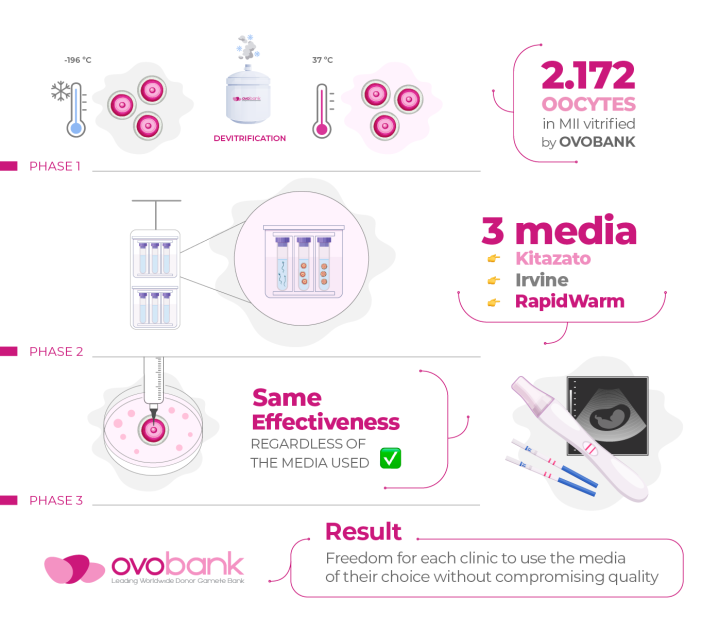
The results of the scientific research showed that there is practically no difference between the study parameters used. This means that it does not matter which donor oocyte devitrification media are used. Therefore, there is no correlation between the media used for vitrification and the media used for oocyte devitrification.
In this way, each centre can use the media of their choice with the same success rate without affecting the oocyte. This is a significant advance for those assisted reproduction clinics that have to work with vitrification and devitrification techniques.
A milestone in the can on Ovolearning
This milestone not only consolidates Ovolearning’s role as a leading platform in embryology training, but also reaffirms the value of shared knowledge as a driver of change in reproductive medicine. Thanks to the research carried out by our professionals, we continue to advance in more effective and safer protocols, which have a direct impact on clinical results and on the real possibilities of those who trust us to fulfil their dream of starting a family.
At Ovoclinic and Ovolearning we will continue to be committed to scientific excellence, continuous training and research with real impact. This study is just one more example of our team’s commitment to the constant improvement of embryology practice, scientific updating and the development of solutions that make a difference.
PUBMED
PubMed is a database of the USA National Library of Medicine that facilitates the search for biomedical and life sciences literature free of charge. In fact, it is the most widely used search engine by health professionals worldwide. All the studies in this library are thoroughly reviewed by professional experts before being published.
Quote from the study published in the Journal of Assisted Reproduction and Genetics on oocyte devitrification
Troncoso-Perez, P., Gonzalez-Navas, C., Coccia, M.E. et al. Application of a single “Universal warming protocol” for vitrified donor oocytes: A multicenter study. J Assist Reprod Genet (2025). https://doi.org/10.1007/s10815-025-03423-7